
You turn on the kitchen faucet for a glass of water. Or you notice white spots on your clean dishes after the dishwasher runs. Your water is “safe” according to the utility… yet something still feels off. Maybe your skin feels dry, your water heater is working harder, or your plumber mentioned scale buildup. This article gives you the clear, no-jargon baseline you need for homes in Fauquier County, Culpeper County, and Rappahannock County, as well as towns like Haymarket, Gainesville, Purcellville, Upperville, and Middleburg.
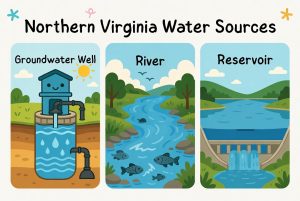
Where Your Water Actually Comes From (Local Snapshot)
Your water doesn’t all come from the same place—and that matters.
- Fauquier County (including Upperville and Middleburg areas) and parts of Rappahannock County rely mostly on groundwater from deep wells.
- Culpeper uses a mix: surface water from Lake Culpeper (a 254-acre reservoir) plus groundwater wells.(
- Haymarket and Gainesville primarily receive surface water from the Potomac River, Occoquan Reservoir, and Lake Manassas, treated by Fairfax Water and delivered via Prince William Water (with some supplemental groundwater wells in certain areas).
- Purcellville blends surface water from the J.T. Hirst Reservoir (fed by Harris and Potts springs) with groundwater wells.
Groundwater typically picks up more dissolved natural minerals as it filters through rock and soil. Surface water can carry more sediment or organic material from runoff. This is one reason water quality and taste can differ from one neighborhood to the next—even within the same county.
How Municipal Water Treatment Works (High-Level Overview)
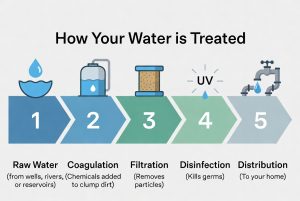
Municipal treatment plants do an impressive job making raw water safe to drink. Here’s the simple version of what happens:
- Coagulation & Sedimentation – Chemicals make tiny particles clump together so they sink out.
- Filtration – Water passes through sand, gravel, or membranes that catch remaining particles.
- Disinfection – Chlorine or chloramine is added to kill bacteria and viruses (Prince William Water/Fairfax area uses chloramine most of the year for longer protection in the pipes; Many smaller local systems continue to use free chlorine as their primary disinfectant.).
- Sometimes fluoride, corrosion inhibitors, or pH adjusters are added for public health.
Local systems tailor the process to their source. In the Prince William Water / Fairfax Water area (serving Haymarket/Gainesville), chloramine is used most of the year for longer-lasting protection in pipes. Other local systems (Fauquier, Culpeper, Purcellville) typically use free chlorine.
Why “Safe” Doesn’t Mean “Ideal”
EPA primary standards protect health and are strictly enforced. Secondary standards address taste, odor, staining, and scaling but are not mandatory. Water that meets legal limits at the plant can still cause household issues by the time it reaches your home.
Common Issues in Our Area
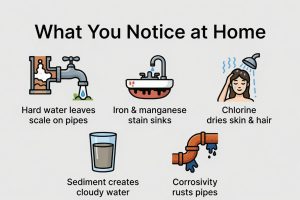
- Hardness (calcium & magnesium): Common in many groundwater systems. While some Fauquier reports show relatively soft averages, well water in the region frequently causes scale due to local geology.
- Chlorine/chloramine: Added for disinfection. Prince William Water switches seasonally between chloramine (most of the year) and free chlorine (spring flushing).
- Sediment and aging infrastructure: Common in older neighborhoods (e.g., parts of Purcellville, Middleburg).
- Iron and manganese: Especially in well-based systems (Fauquier wells, Purcellville groundwater). These cause red/brown/black stains.
- pH and corrosivity: Some local groundwater is slightly acidic (low pH), which can slowly corrode pipes.
How Water Changes Between the Plant and Your Tap
Water can pick up trace metals or sediment from old pipes, lose some disinfectant strength, or form disinfection byproducts as it travels. Seasonal changes and neighborhood differences also play a role.
Real-World Impacts on Your Home and Family
These issues aren’t just annoying—they add up:
- Scale shortens the life of water heaters, dishwashers, and washing machines
- Stains ruin laundry and fixtures
- Dry skin and hair from chlorine/chloramine
- Higher soap and energy bills
- More frequent plumbing repairs
A properly designed treatment system protects your investment and makes daily life noticeably better.
Why Testing Matters Before Choosing a Solution
Utility Consumer Confidence Reports (CCRs) test at the plant, not your tap. Street-to-street and season-to-season variations are real. A professional whole-house test (often free from your plumber) shows exactly what’s in your water.
Next Steps
Your municipal water is safe and well-regulated. Understanding what reaches your tap helps you protect your home and family.
Schedule your free water test today. We’ll explain everything in plain English.
Sources
- Fauquier County Water Resources
- Lake Culpeper (Virginia DWR)
- Lake Culpeper Overview
- Prince William Water
- Fairfax Water
- Town of Purcellville Utilities
- Prince William Water Annual Flushing Program
- CDC Chlorine and Chloramine Overview
- CDC Water Disinfection Overview
- Virginia Cooperative Extension Well Water Resources